Multitouch improved on iOS 6
by Justin Horn on Sep 11th, 2012 @ 1:22 pmUPDATE 2 Looks like we now have the biggest reason for this change, the iPad mini.
I noticed recently that multitiouch on iOS 6 beta seems to have improved, it now recognizes a second finger touch. On iOS 5 a touch with a second finger while the first finger was still on the screen would ignore all input from the second finger. After noticing this improvement, I double checked I wasn’t crazy by testing this on my girlfriend’s iPhone 4 with iOS 5 (don’t feel too bad, I’m getting her an iPhone 5 soon) and it worked as I remembered. I haven’t tested on a 4S with iOS 5 since noticing this, but I’m pretty confident this is a software related, not hardware.
Hoping that this is the first step to bringing multitouch gestures to the iPhone.
UPDATE Just to clarify a little more, this is different than the previously usable multitouch gestures, like pinch to zoom. This is basically recognizing two simultaneous inputs doing non-gestures. Like in my demo video below, just a regular swipe up and down. You can also see when I bring the two fingers towards each other the slide up and down cancels out.
Here’s a short video demonstrating what I mean by multiple touch inputs.
Follow me on Twitter @justin_horn
Shit Apple fanatics say, part 2
by Justin Horn on Sep 7th, 2012 @ 5:14 pmThis one is better than part 1.
(via iDownloadBlog)
Follow me on Twitter @justin_horn
Comments Off
Featured post, Humor, iOS, iPad, iPhone
The iPad 2 banned promo video…winning!
by Justin Horn on Mar 4th, 2011 @ 10:21 amFrom the guys that brought you “Banned iPhone 4 Promo”, “Another Banned iPhone 4 Promo”, and “Banned White iPhone 4 Promo”, comes the new “Banned iPad 2 Promo”.
Also, for your enjoyment, the other banned promos.
(via techgadgetx.com)
Follow me on Twitter @justin_horn
Comments Off
Featured post, Humor, iPad
iOS Nike+ heart rate monitor support most likely an iOS 4.2 addition later this year (Updated)
by Justin Horn on Aug 31st, 2010 @ 1:58 pmUPDATE iOS 4.2 for iPhone, iPad, and iPod confirmed for November
UPDATE 2 As execpted Nike+ HRM support did not appear in iOS 4.1 GM, but there is a strong chance it will be in iOS 4.2.
We reported a couple weeks ago that iOS heart rate monitor (HRM) support was coming this fall. Logically I assumed (or wishful thinking?) this would fit nicely with the final iOS 4.1 release. As of beta 3, released August 3, there was no support, but I was hoping to see it introduced in beta 4. It’s been almost a month since beta 3 was released and with the fall event scheduled for tomorrow, there is basically no chance we’ll see this in iOS 4.1.
If not in iOS 4.1, I thought we might be waiting till iOS 5 for support. Remember there was no iOS 3.2 release last year (not counting the special iPad only version) and this isn’t something you’d see in a small iOS 4.1.1 update. However, I did suggested there was a small chance for an iOS 4.2 release later this year, which could definitely include HRM support.
John Gurber suggest, due to the lack of iOS 4.1 iPad beta, there is a good chance for a 4.2 update later this year:
As for the iPad, no, I don’t think 4.1 is going to be released for it. iOS 4.2, coming late in the calendar year, is a more likely unification release for all iOS devices. Think about it — how can Apple release iOS 4.1 for the iPad next week if they haven’t released a single beta for developers?
This makes sense a lot of sense and backs up my hopes for a possible iOS 4.2 release for iPhone, iPod, and iPad. This update would happen before years end and still fits in with the fall prediction, which covers from early September (labor day) through late December (around the 20th).
Follow me on Twitter @justin_horn
Comments Off
Featured post, iOS 4.1, iOS 4.2, iPhone, iPod, Nike+, Speculation
Video: Nike+ over air sync on iOS 4.1 beta
by Justin Horn on Aug 4th, 2010 @ 11:29 pmUPDATE Confirmed this is still in final iOS 4.1 GM release! No magic disappearing OTA sync this time.
Nike+ over air syncing first appeared in iOS 4.0 beta, but was removed early on in the beta cycle. Even when it was still active, it never was able to send the data to Nike’s servers. Over air syncing made its triumphant return in first iOS 4.1 beta and has stuck through yesterday’s beta 3. Also, as you can see from the video, on iOS 4.1 beta it actually works.
So the fact that it’s still in beta 3 and the Nike+ servers are now ready to accept the data, there is a strong chance this update will make it into the final iOS 4.1 release.
Follow me on Twitter @justin_horn
Charging the iPhone 4: USB vs Outlet
by Justin Horn on Jul 8th, 2010 @ 4:39 pmAlmost 2 years ago I did this comparison for the iPhone 3G. As the 3GS was similar to the 3G and it’s a time consuming pain in the ass to do this test, I decided to skip it last year. To make up for my break, I tried to make this test a bigger pain by taking readings every 5 minutes. The extra work paid off, the iPhone 4 charging chart is much smoother and accurate!
Test Conditions
- Started with completely dead iPhone.
- Wall outlet charged on standard US 120 Volt / 60 Hz using Apple include plug adapter and USB cable
- USB charged on late 2008 13″ aluminum MacBook.
- iPhone was checked quickly (1-2 seconds of screen time) every 5 minutes for it’s current charge. This was done for both test so even if it had a minimal impact on charge time, the comparison would still be equal.
- iPhone screen was kept at very dim level to lessen the impact of checking charge.
- WI-FI was kept off.
- iPhone 4 was active on AT&T 3G during charge. I had some activity on the phone while charging, but it was very minimal and should not impact the results.
- During outlet test I received 2 text, a phone call (canceled call), and 1 voice-mail from the canceled call.
- During USB test I received 1 text.
Conclusions
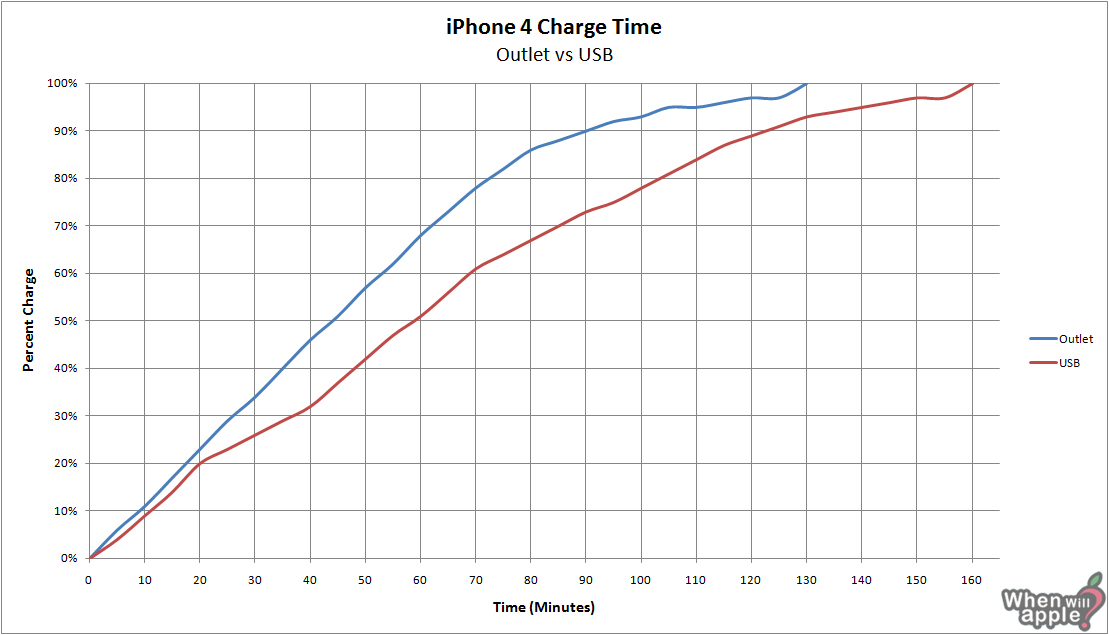
Stating the obvious, the iPhone 4 takes longer to get a full charge on USB than an outlet. What you may not have realized is how big the difference was, an extra 30 minutes! That’s 23% longer to get a full charge on the USB. If you’ve ever had a completely drained iPhone, you know it takes a bit of time before it turns back on. Plugged into an outlet, it took 3 minutes 11 seconds to come back to life. On USB it took almost 2 minutes longer, 4 minutes 49 seconds.
Obviously the convenience of USB charging is great, but if you’re in a rush to get charged and get out of the house, always go for the outlet.
Compared to the 3G
The 3G took 90 minutes for a full charge on outlet, about 31% faster than a full charge for the iPhone 4′s 130 minutes. On USB the 3G took 140 minutes, about 13% faster than the iPhone 4′s 160 minutes. Keep in mind that the iPhone 4 has about a 20% larger battery, so it makes complete sense that it takes longer to charge.
Follow me on Twitter @justin_horn